

| Capital at risk. All investments involve risk and investors may not get back the amount originally invested. |
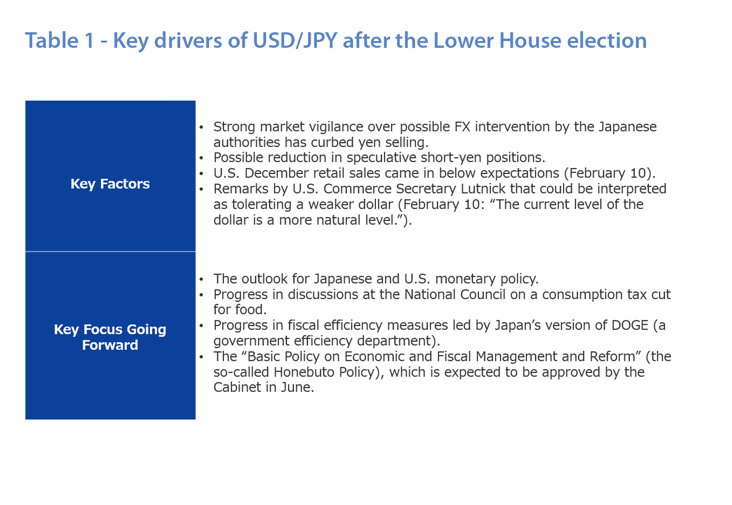
Our view is that the post-election yen appreciation was driven by an unwinding of short-yen positions amid heightened vigilance over possible FX intervention, as well as multiple factors weighing on the U.S. dollar.
Remarks by Prime Minister Takaichi and others are gradually reinforcing the view that fiscal policy will be pragmatic, potentially easing upward pressure on long-term interest rates by reducing doubts around Japan’s fiscal sustainability.
While it remains necessary to calmly and objectively assess the Takaichi administration’s fiscal management, we view the risks of a sharp yen sell-off and a spike in long-term interest rates as now very limited.
The dog that didn’t bark
For the House of Representatives election held on February 8, markets had largely expected that a victory for the ruling parties would lift equities, weaken the yen, and push long-term interest rates higher. In reality, however, while the Nikkei posted a sharp gain, USD/JPY moved in the opposite direction—toward dollar weakness and yen strength—and long-term rates did not rise significantly. This sudden strengthening of the yen caught many market participants by surprise. Below, we examine why USD/JPY and long-term interest rates moved contrary to expectations and provide an outlook going forward.
Starting with USD/JPY, there was an initial if only brief reaction where a stronger dollar and weaker yen were seen in the early hours of February 9 (Japan time). SMDAM’s house view is that this first bout of post-election yen depreciation was limited due to very strong market vigilance over possible FX interventions by the Japanese authorities. In this regard, market speculation that emerged in late January about “rate checks” by the Japanese and U.S. authorities appears to have been a factor, contributing to a reduction in speculative short-yen positions. Additionally, as shown in the table below, the existence of multiple factors weighing on the U.S. dollar likely also played a role in a relative sense.
Takaichi’s balance between responsibility and radicalism
Turning to long-term interest rates, while the 10-year JGB yield rose on the 9th, it fell on the 10th, remaining relatively calm overall and maintaining the heightened level it has reached over recent months. The market had been focused on what Prime Minister Takaichi would say about fiscal management after the Lower House election. At a much anticipated press conference on February 9 she stated that the consumption tax on food would be set to zero for a limited period of two years, that the funding would not rely on special deficit-financing bonds, and that she would like to compile an interim summary at the National Council before early summer.
As can be summed up in the table below, we see the policy measures as part of a broader picture which suggests upward pressure on long-term rates.
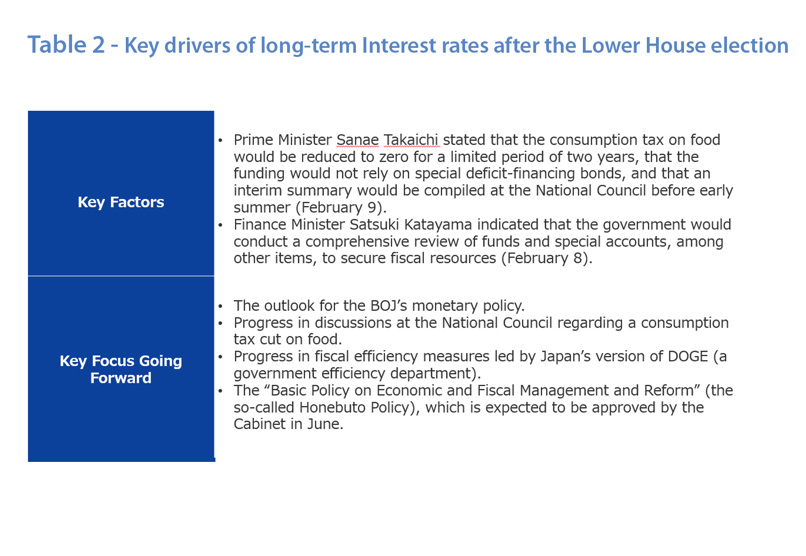
In addition, on the 8th, Finance Minister Katayama disclosed on national TV that the government intends to thoroughly review broad government spending to identify where savings on fiscal resources can be made, regarding a cut in the consumption tax on food. In response to these remarks, the view has gradually spread that the Takaichi administration will pursue highly pragmatic fiscal management, and as concerns about fiscal deterioration and accelerating inflation have eased to some extent, we suspect upward pressure on long-term interest rates has declined—also contributing to a check on yen depreciation.
Has the worst volatility already passed?
However, we believe it will still take time for the Takaichi administration’s fiscal policy to win the market’s confidence, and we continue to see an environment in which yen depreciation and rising long-term interest rates could occur relatively easily. That said, even if USD/JPY moves back above 157 and the dollar strengthens against the yen, a rapid move beyond 160 seems unlikely given strong market vigilance over potential FX intervention. In addition, when assessing the outlook for USD/JPY, monetary policy by the BOJ and the U.S. Federal Reserve will also be in focus.
For the 10-year JGB yield, the key question is whether it will break above the recent 2.35% level. Exactly how the Takaichi administration’s patented ‘responsible proactive fiscal policy’ will be implemented remains to be seen, and attention will be on discussions at the National Council as well as progress in fiscal efficiency measures led by the Japanese version of DOGE (a government efficiency department bearing some limited resemblance to the US department briefly led by Elon Musk).
Our view is that while the broad direction of the Takaichi administration’s fiscal policy may be expansionary, it is highly likely that she and her team will show some regard for fiscal discipline given the need to keep the bond market calm. This means Takaichi is unlikely to be fully unrestrained in her approach, and accordingly, we see limited risk of a sharp spike in long-term interest rates.
Invest with us
If you have any account or dealing enquiries, please contact BBH using the following contact details:
Brown Brothers Harriman (Luxembourg) S.C.A.
80, route d’Esch, L-1470 Luxembourg
T: +352 474 066 226
F: +352 474 066 401
E: Lux.BBH.Transfer.Agent@BBH.com

Richard HAXE
Managing Director, Head of Business Development

Alex BARRY
Executive Director, Head of Distribution - UK and Ireland

Chloé CHOQUIN
Director, Business Development & Client Relations

Thomas CARTWRIGHT
Director, Business Development & Client Relations
|
Disclaimer An investment’s value and the income deriving from it may fall, as well as rise, due to market and currency fluctuations. Investors may not get back the amount originally invested. The information on this website is not intended to be investment advice, tax, financial or any other type of advice, and is for general information purposes only without regard to any particular user's investment objectives or financial situation. The information is educational only and should not be construed as an offer, solicitation, or recommendation to buy, sell, or transact in any security including, but not limited to, shares in any fund, or pursue any particular investment strategy. Any forecasts, figures, opinions or investment techniques and strategies set out are for information purposes only, and are based on certain assumptions and current market conditions that are subject to change without prior notice. The views of Sumitomo Mitsui DS Asset Management (UK) Limited reflected may change without notice. In addition, Sumitomo Mitsui DS Asset Management (UK) Limited may issue information or other reports that are inconsistent with, and reach different conclusions from, the information presented in this report and is under no obligation to ensure that such other reports are brought to the attention of any recipient of this report. Decisions to invest in any fund are deemed to be made solely on the basis of the information contained in the prospectus and the PRIIPS KID accompanied by the latest available annual and semi-annual report. |
 United Kingdom
 Switzerland
 Luxembourg
 Germany
 Finland
 Ireland
 Netherlands
 Rest of EEA
 Middle East
 Japan 日本
 Hong Kong 香港
 Singapore 新加坡
 USA
USA
 Other
Other