
| Capital at risk. All investments involve risk and investors may not get back the amount originally invested. |
With the Nikkei having now reached and exceeded its previous all-time high, investors are asking what is next for the Japanese market. What does the near- and long-term look like for Japanese equities, and can they sustain life at this elevated altitude?
Highlights:
|
Is it too soon to bet on peace?
On May 25, the Nikkei closed at 65,158.19 yen, up 2.9% from the previous weekend, surpassing the key 65,000-yen level and reaching a new all-time closing high. In the weeks since, the market has continued to rally and now resides above 70,000.
Positive sentiment was partly supported by a weekend Axios report citing a senior U.S. official who said the United States and Iran were close to an agreement that included a 60-day ceasefire extension. Buying, led by richly valued semiconductor stocks, pushed the Nikkei higher that day.
In considering the outlook for the market going forward, careful assessment of the still-unpredictable Middle East situation remains necessary. We have previously commented on the profound uncertainty this conflict has unleashed, and cautioned against investors jumping to conclusions too hostility which might prove false as new information appears.
Importantly, despite limited hostilities on May 26–27, the market appears to view these as exceptions rather than a return to full conflict. With U.S. midterm elections in November and Iran’s domestic economy under strain, ending the conflict may be a realistic option for both countries. This view seems to be spreading in the stock market, and unless U.S.–Iran fighting resumes or escalates, we believe the market has moved past the stage where delays in reaching an agreement would trigger sharp declines.
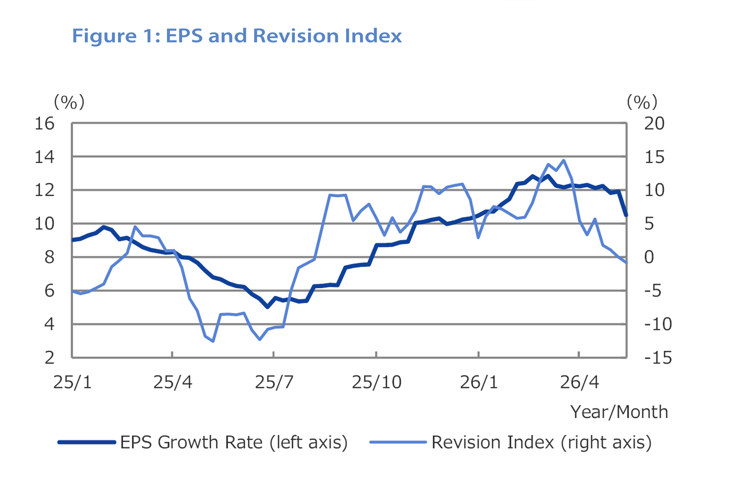
Source: Prepared by Sumitomo Mitsui DS Asset Management based on data from Datastream.
Going forward, if the U.S. and Iran reach a deal to end the fighting, upward revisions in market forecasts are highly likely. As soon as expectations grow for improved company guidance, we expect to see the rally strengthen.
This expectation that the rally will in all likelihood have further to run has led some analysts to caution that signs of overheating may appear.
However, across the broader Japanese market valuations remain moderate and we see this as a stabilising factor moderating the rally. For instance, the 12-month forward price-to-earnings ratio for the TOPIX stands at just 16.5, compared with 21.1 for the S&P 500 and 26.2 for the Nasdaq Composite. Whilst Japan has tended to trade at a discount relative to the US, this gap does mean investors in Japan have less to fear as Japanese stocks are not ‘priced for perfection’ as they are in the US.
As we have discussed before, Japan is relatively well endowed with industrially competitive companies in various market niches, and these firms are now strong candidates to go ahead and grow their earnings well when a full settlement of the Middle east crisis is reached.
What comes after 70,000 for the Nikkei?
From here, we see the Nikkei staying range-bound near its current level or dipping to around 68,100 by year-end in our core scenario, with the upper end of the forecast range for each quarter reaching up to 74,900 yen. In addition, the upper end of each quarterly forecast range is set above 70,000 yen.
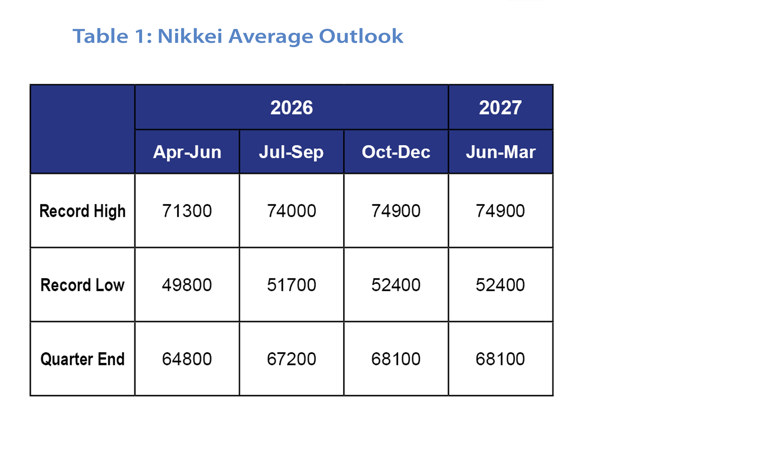
Source: Prepared by Sumitomo Mitsui DS Asset Management.
In addition, the upper end of each quarterly forecast range is set above 70,000 yen. If the Nikkei firmly establishes itself in the 65,000-yen range and Middle East tensions ease, a move toward 70,000 yen within the year may become more clearly defined.
In Japan, amid expected underlying inflation, the average wage increase in the 2026 spring labour negotiations exceeded 5% for a third straight year, and efforts to improve corporate capital efficiency continue.
Furthermore, if revisions to the Corporate Governance Code this year encourage companies to use cash and deposits more actively for growth investment, improvements in ROE can also be expected. If the Basic Policy on Economic and Fiscal Management and Reform, due in June, further boosts expectations for growth investment, the environment for stock prices is likely to become even more favourable.
Invest with us
If you have any account or dealing enquiries, please contact BBH using the following contact details:
Brown Brothers Harriman (Luxembourg) S.C.A.
80, route d’Esch, L-1470 Luxembourg
T: +352 474 066 226
F: +352 474 066 401
E: Lux.BBH.Transfer.Agent@BBH.com

Richard HAXE
Managing Director, Head of Business Development

Alex BARRY
Executive Director, Head of Distribution - UK and Ireland

Chloé CHOQUIN
Director, Business Development & Client Relations

Thomas CARTWRIGHT
Director, Business Development & Client Relations
|
Disclaimer An investment’s value and the income deriving from it may fall, as well as rise, due to market and currency fluctuations. Investors may not get back the amount originally invested. The information on this website is not intended to be investment advice, tax, financial or any other type of advice, and is for general information purposes only without regard to any particular user's investment objectives or financial situation. The information is educational only and should not be construed as an offer, solicitation, or recommendation to buy, sell, or transact in any security including, but not limited to, shares in any fund, or pursue any particular investment strategy. Any forecasts, figures, opinions or investment techniques and strategies set out are for information purposes only, and are based on certain assumptions and current market conditions that are subject to change without prior notice. The views of Sumitomo Mitsui DS Asset Management (UK) Limited reflected may change without notice. In addition, Sumitomo Mitsui DS Asset Management (UK) Limited may issue information or other reports that are inconsistent with, and reach different conclusions from, the information presented in this report and is under no obligation to ensure that such other reports are brought to the attention of any recipient of this report. Decisions to invest in any fund are deemed to be made solely on the basis of the information contained in the prospectus and the PRIIPS KID accompanied by the latest available annual and semi-annual report. |

 United Kingdom
 Switzerland
 Luxembourg
 Germany
 Finland
 Ireland
 Netherlands
 Rest of EEA
 Middle East
 Japan 日本
 Hong Kong 香港
 Singapore 新加坡
 USA
USA
 Other
Other