

| Capital at risk. All investments involve risk and investors may not get back the amount originally invested. |
"The wise man does at once what the fool does finally”
Niccolo Machiavelli
Nobody could accuse Japan’s first female Prime Minister of procrastination when decisions have to be made. The results are now in, and the gamble of calling a snap election has paid off. Japan has voted with conviction for Prime Minister Sanae Takaichi and her agenda of fiscal rejuvenation to continue. With a majority of 316 seats out of a total of 465 in the Lower House, the wind is firmly in Takaichi’s sails and the path ahead is clear for Japan for the next few years.
What does this landmark event in Japan’s recent history mean for investors?
This is the first time in the postwar era that a single party has held more than two-thirds of the House—truly a historic landslide. Within the ruling coalition, Nippon Ishin won 36 seats (+2), bringing the LDP–Ishin total to 352 seats (232 before the election).
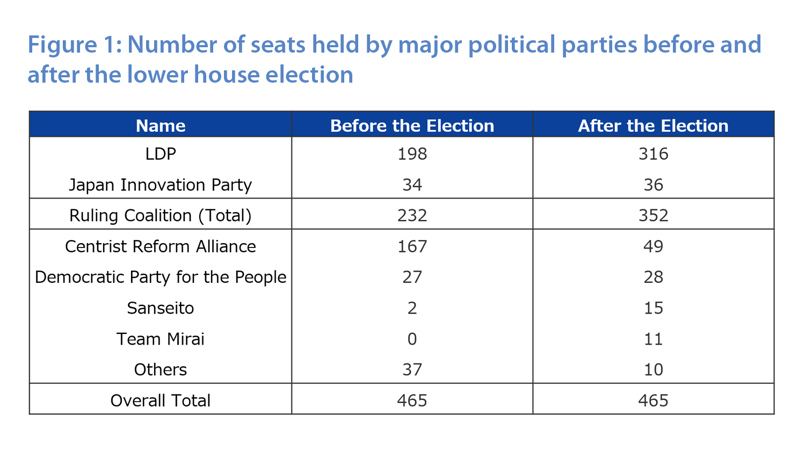
In response to the Lower House election results, the Nikkei surged sharply, and an early move to the 60,000 level is increasingly coming into view. USD/JPY is likely to remain sensitive amid heightened vigilance over potential intervention, while long-term rates should stay jittery as the market assesses fiscal management—pointing to nervous trading ahead on both fronts.
Political fatigue? Not at this pace!
All in all, it was just one short month from when it was reported that Takaichi was considering dissolving the House of Representatives on January 9 to when the elections were held on February 8.
This is assumed to have been partly motivated by a desire to strike before the opposition was fully organised, and partly by the belief that the enthusiasm of the ‘honeymoon’ period may cool if volatility continued to spike in the bond market.
The rapidity of events has – with hindsight now the results are in – certainly worked to her advantage. While today some other developed democracies suffer from a level of political fatigue after years of rancour and polarisation, Japan’s electorate have a noticeably more optimistic disposition. They have voted for an energetic leader to have the majority needed to put her agenda into practice.
As well as the speed with which Takaichi has acted, the broadly positive message of her campaign has resonated well with the voters, and this is reflected in both her and her cabinets high approval ratings and the historic super-majority her coalition now commands in the lower chamber of the national parliament.
Can the bond market take the strain?
Takaichi herself has termed her approach as ‘responsible proactive fiscal policy’. This may sound contractionary to some in the bond market, but in general equities have responded well to her pro-growth, pro-investment agenda.
The main issue that is keeping Japan watchers up at night is and will likely remain the deficit spending that is now firmly established as Takaichi’s hallmark. Indeed, the expectation that Takaichi will move to cut consumption tax emerged as one of the key campaign issues and now looks likely to occur, with potential inflationary consequences. Value-added taxes on food items in particular have been highly controversial since the return of inflation has started to bite Japanese consumers. The possibility of tax cuts has therefore been both popular and controversial in equal measure, and may be more likely now that both her personal and her parties political capital has been augmented.
However, there is a meaningful fork in the road ahead even if we assume fiscal expansion in general is the name of the game. A key question now is whether Takaichi primarily deploys the fiscal largesse she seeks to accelerate growth and investment via supply-side interventions, or whether the main focus is placed on redistribution via such mechanisms as the proposed consumption tax cut.
The key expectations we have in each of these two scenarios is set out in the table below:
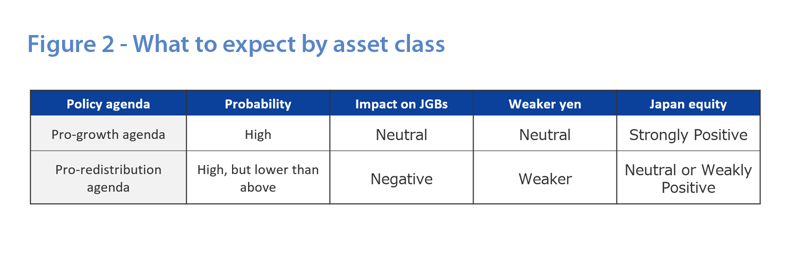
Our house view is that if the former takes precedence, this will be a clear positive for Japanese equities, potentially containing market concerns over fiscal expansion and helping to stabilize politically sensitive long-term yields.
Broadly, “responsible proactive fiscal policy” should lift the economy in the short term, while “crisis management and growth investment” are expected to strengthen Japan’s growth potential over the medium to long term. Policy support is also likely to reinforce the structural shifts already under way—macroeconomically, Japan’s exit from deflation; and microeconomically, ongoing corporate reform. The government’s policy stance should become more concrete in the summer through the Basic Policy (“honebuto”) and the Growth Strategy, and then move steadily into implementation.
If the Takaichi administration promotes disciplined fiscal management and growth-oriented investment while showing some consideration for fiscal rules, market confidence is likely to improve rapidly. A so-called crowding-in effect is also possible, whereby increased public investment into strategic sectors encourages subsequent private capital to move in a similar direction. Provided the Bank of Japan can conduct appropriate monetary policy, the equity rally should continue, while the rise in long-term interest rates and yen depreciation are likely to moderate.
However, if market confidence is not secured and appropriate monetary policy cannot be implemented, risks remain that long-term interest rates will continue to rise and the yen will keep weakening, potentially weighing on equity prices.
On the other hand, if the second, more redistribution-focused approach comes to dominate the agenda, there is a real danger that a cocktail of increased inflation and aggressive selling at the long end of the curve will continue to make matters worse in the bond market.
We will be watching closely to see how this tension is resolved in the weeks and months ahead, but our house view is that Takaichi is likely to pursue a pro-growth, pro-investment approach.
Implications for financial markets
Looking at how the TOPIX performed around previous snap lower-house elections since 2000 (comparing 30 days before dissolution with 360 days after), the average return when the LDP wins is 24.6%, well above the overall average of 14.2%.
With the LDP’s landslide victory, the Takaichi administration’s political base and resources have strengthened significantly. As improvements in fundamentals—Japan’s exit from deflation and corporate reform—are expected to continue, markets should respond positively if the administration allocates political capital effectively to economic policy, increasing the durability of domestically driven support for stocks. We forecast TOPIX at 3,800 and the Nikkei 225 at 57,000 at end-March, and TOPIX at 3,910 and the Nikkei 225 at 58,700 at year-end, with potential upside.
Meanwhile, the bond market and the yen are likely to remain sensitive as investors gauge the extent of fiscal expansion. The key focus is the Prime Minister’s stated “long-cherished goal” of zero consumption tax on food for two years. Will the government truly proceed; if so, how will it fund the required JPY 5 trillion; and can it credibly raise the tax again after two years? Fiscal challenges are far from trivial. Bond investors remain cautious, and moving to a consumption tax cut without resolving these issues could raise long-term rate volatility.
Yen volatility in the Year of the Fire Horse
Turning to the FX market, USD/JPY finished the New York session at the end of last week around ¥157.22 per dollar, but in the early hours of February 9 (Japan time) it was briefly seen reaching around ¥157.76. Going forward, a resumption of the so-called “Takaichi trade” could create an environment in which the yen tends to weaken. However, with lingering vigilance over possible FX intervention by the government and the BoJ, a sharp bout of yen depreciation is unlikely; we expect nervous trading as the market watches for signs of intervention.
In the bond market, the benchmark March JGB futures contract fell, and on February 9 it briefly traded at ¥131.10, down ¥0.49 from the previous Friday.
Following the Lower House election results, some market participants appear to expect Prime Minister Takaichi to accelerate fiscal expansion further, while others see less need to accommodate the opposition on fiscal matters—potentially allowing a shift toward a more realistic fiscal stance.
The road ahead
The exact shape of fiscal expansion will become clear in the near term now that Takaichi has won her mandate.
However, even with the precise outline of the policy agenda yet to be revealed, our house view is that the removal of uncertainty and the achievement of a clear mandate are both positive for Japanese assets.
The Year of the Fire Horse according to the Japanese zodiac commences on February 17. Takaichi has followed Machiavelli’s dictum and moved decisively to secure what she needs. With the direction of travel clear, our house view is that the weather is now favourable for Japanese markets, and despite legitimate concerns about fiscal sustainability, we expect growth to allow Japan to balance fiscal expansion against debt sustainability concerns.
Invest with us
If you have any account or dealing enquiries, please contact BBH using the following contact details:
Brown Brothers Harriman (Luxembourg) S.C.A.
80, route d’Esch, L-1470 Luxembourg
T: +352 474 066 226
F: +352 474 066 401
E: Lux.BBH.Transfer.Agent@BBH.com

Richard HAXE
Managing Director, Head of Business Development

Alex BARRY
Executive Director, Head of Distribution - UK and Ireland

Chloé CHOQUIN
Director, Business Development & Client Relations

Thomas CARTWRIGHT
Director, Business Development & Client Relations
|
Disclaimer An investment’s value and the income deriving from it may fall, as well as rise, due to market and currency fluctuations. Investors may not get back the amount originally invested. The information on this website is not intended to be investment advice, tax, financial or any other type of advice, and is for general information purposes only without regard to any particular user's investment objectives or financial situation. The information is educational only and should not be construed as an offer, solicitation, or recommendation to buy, sell, or transact in any security including, but not limited to, shares in any fund, or pursue any particular investment strategy. Any forecasts, figures, opinions or investment techniques and strategies set out are for information purposes only, and are based on certain assumptions and current market conditions that are subject to change without prior notice. The views of Sumitomo Mitsui DS Asset Management (UK) Limited reflected may change without notice. In addition, Sumitomo Mitsui DS Asset Management (UK) Limited may issue information or other reports that are inconsistent with, and reach different conclusions from, the information presented in this report and is under no obligation to ensure that such other reports are brought to the attention of any recipient of this report. Decisions to invest in any fund are deemed to be made solely on the basis of the information contained in the prospectus and the PRIIPS KID accompanied by the latest available annual and semi-annual report. |
 United Kingdom
 Switzerland
 Luxembourg
 Germany
 Finland
 Ireland
 Netherlands
 Rest of EEA
 Middle East
 Japan 日本
 Hong Kong 香港
 Singapore 新加坡
 USA
USA
 Other
Other