

| Capital at risk. All investments involve risk and investors may not get back the amount originally invested. |
Stocks, bonds and the currency have all slid recently in Japan, as the pace of change under the new Prime Minister has surprised many market observers. However, whilst the radical stimulus agenda championed by Sanae Takaichi represents short-term volatility, looking further ahead her policy platform has one goal and one goal only – to breathe fresh life into the Japanese economy and finally banish the deflation that strangled growth since the great crash of the late 1980s. In the few short weeks since her election, Japanese politics has been transformed almost beyond recognition by Takaichi and her team. Where previously there was caution and continuity, today there is energy, vigor and a genuine willingness to pull all of the levers available to the government to get the economy moving again. Markets have watched breathlessly as large-scale fiscal stimulus has been announced, a new administration formed and set to work in rapid fashion, and a newly confident Japan has re-entered the global arena.
However, all this change has generated substantial dislocations in the markets for Japanese stocks and bonds, as well as the yen. In this article we look at what impact these policy changes have had so far, and consider if the so-called ‘triple depreciation’ underway today could represent an opportunity for foreign investors.
What has happened so far?
- The Nikkei has slid recently, in our opinion largely due to the market beginning to reappraise global AI-related stocks.
- However, we expect the index to rebound over December after Nvidia’s strong earnings report suggested the AI trade remains at least partly intact. Government bond yields have risen sharply. We suspect that this increased selling activity is due to concerns about the fiscal situation deteriorating as Takaichi’s stimulus package takes shape.
- To allay fears, the government should hasten to present a blueprint for achieving fiscal stability in the medium-term to avoid a further sharp rise in yields. In this regard, we hope that Takaichi’s team have fully absorbed the lessons of the now infamous Liz Truss ‘mini-budget’, where the short-lived UK Prime Minster suddenly unveiled a series of large-scale, unfunded tax cuts which she promptly had to reverse out of when the bond market reacted negatively.
- Alongside both of these downward moves in the equity and bond markets, the depreciation of the yen has continued. Our view is that this is driven by concerns over fiscal deterioration and speculation about at what level currency intervention will become more likely. We see the situation today as highly fluid, and if the yen depreciates further or the pace of the decline accelerates, close attention should be paid to all statements from senior Ministry of Finance officials.
Interpreting the ‘triple depreciation’
The situation above is best summarized as a synchronized movement of ‘triple depreciation’ where stocks, government bonds, and the yen are all being sold off simultaneously.
For investors, the simultaneous downward movement in stocks, bonds and currency can be read in multiple ways, but as we will argue below all three are a function of the radical reform agenda launched by Takaichi. As such, investors who positively evaluate this program might see the decline in prices of Japanese assets as an opportunity.
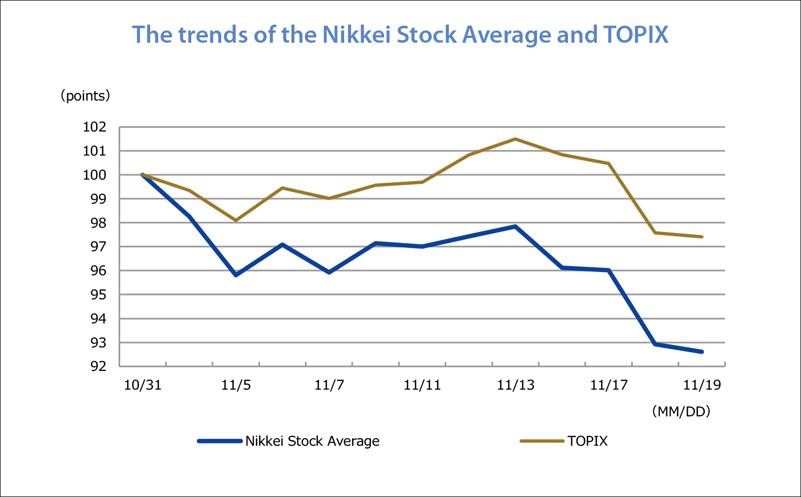
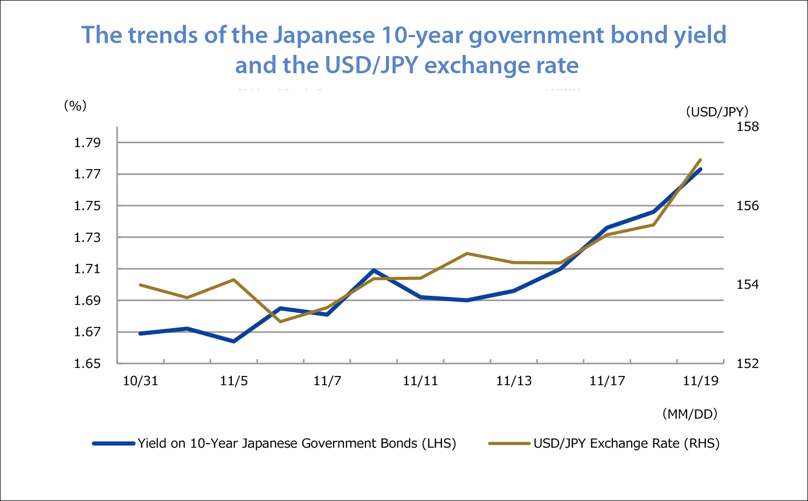
As can be seen in the charts below, the movements in stocks and bonds are closely correlated, with both asset classes finding more marginal sellers than buyers recently leading to large downward swings.
What this means for investors in the Japanese market is complicated and needs to be put in the context of the unprecedented political changes afoot in Japan today.
Firstly, regarding stocks, the Nikkei average fell by 3,873.64 yen (7.4%) from the closing price record set on October 31 to November 19. Particularly notable in leading this decline were the mega-cap of SoftBank Group, Advantest, and Tokyo Electron. However, since this low point, the market has rallied effectively and regained almost all of this lost ground. As such, we interpret this downwards move as a short-term market response to the increased policy dynamism of the new government, which once market participants had had a little longer to digest was swiftly reversed.
Focusing in on the names above, the decline in these three stocks is believed to be influenced by the ongoing appraisal of U.S. and global AI related stocks which are seeing significant swings each way as investor grapple with the issue of how to value these companies. The movements seen in these three names effectively served to augment the decline in the Nikkei average which is highly susceptible to movements in a small number of high-priced stocks. For reference, the drop in the more diversified and less influenced by single names TOPIX during the same period was limited to 2.6%.
How to handle the bond market?
Given that we see the increased selling of government bonds as being due to concerns about fiscal deterioration, it is highly important that the government soon presents their plans and forecasts for how they expect to gradually steer towards fiscal stability. The rise in yields has so far been very sharp, and it is the next big test of the new government if they can successfully communicate their intentions to the bond market to calm jitters over debt and deficit sustainability.
As has been widely commented on already, the yields on long-term and super long-term government bonds have recently risen significantly. Our view is that this is a short-term and potentially quite short-sighted response to the expected increase in government debt issuance tied to Prime Minister Takaichi’s hyper-aggressive fiscal policy. It has been reported that the government is adjusting the scale of its stimulus measures to around 17 trillion yen, but on November 18, a group of Liberal Democratic Party lawmakers requested Prime Minister Takaichi to expand the supplementary budget for fiscal year 2025 to 25 trillion yen. With the precise scale and targets of the stimulus package still to be finalized, it is understandable that participants in the bond market has signaled their concern. However, our view is that the stimulus package is likely to be a net positive for the Japanese economy over a medium-term horizon, and investors have generally reacted favourably to the signs that the government is serious about restarting growth.
By the end of November, the interventionist policies including measures to counter rising prices were provisionally approved at a level of around 21.3 trillion yen. At this time, Prime Minister Takaichi stated, “Responsible aggressive fiscal policy must be trusted by the market.” It would be fair to say this is still a work in progress, although Takaichi has done much already to allay fears around fiscal irresponsibility. More will be needed on this, however, so we see further announcements coming soon along these lines.
How low is too low?
Lastly, regarding the yen, its depreciation against major currencies has now become extremely pronounced, with the USD/JPY exchange rate reaching as high as 157.18 yen per dollar on November 19. In addition to concerns that Prime Minister Takaichi’s aggressive fiscal policy could lead to fiscal deterioration, the yen selling appears to be driven by anxiety of the sustainability of Japan’s fiscal path.
Our view is that in prioritizing growth over short-term stability, the new government is making a bold and significant choice that will have far-reaching consequences for the Japanese market. Whilst it is too soon to say definitively what the outcome will be, her first steps have been assured and confident, and as such suggest she and her team have a coherent plan for the road ahead.
In the near term, we will be paying close attention to the levels of speculative dollar buying and yen selling movements. These will test the levels at which the government and the Bank of Japan might intervene to support the currency by selling dollars and buying yen. Looking further ahead, statements from senior Ministry of Finance officials will be closely watched. Comments such as “no options are off the table” or “we will take decisive action” suggest an increased likelihood of intervention, while comments like “we are always prepared” indicate that intervention might be imminent.
Invest with us
If you have any account or dealing enquiries, please contact BBH using the following contact details:
Brown Brothers Harriman (Luxembourg) S.C.A.
80, route d’Esch, L-1470 Luxembourg
T: +352 474 066 226
F: +352 474 066 401
E: Lux.BBH.Transfer.Agent@BBH.com

Richard HAXE
Managing Director, Head of Business Development

Alex BARRY
Executive Director, Head of Distribution - UK and Ireland

Chloé CHOQUIN
Director, Business Development & Client Relations

Thomas CARTWRIGHT
Director, Business Development & Client Relations
|
Disclaimer An investment’s value and the income deriving from it may fall, as well as rise, due to market and currency fluctuations. Investors may not get back the amount originally invested. The information on this website is not intended to be investment advice, tax, financial or any other type of advice, and is for general information purposes only without regard to any particular user's investment objectives or financial situation. The information is educational only and should not be construed as an offer, solicitation, or recommendation to buy, sell, or transact in any security including, but not limited to, shares in any fund, or pursue any particular investment strategy. Any forecasts, figures, opinions or investment techniques and strategies set out are for information purposes only, and are based on certain assumptions and current market conditions that are subject to change without prior notice. The views of Sumitomo Mitsui DS Asset Management (UK) Limited reflected may change without notice. In addition, Sumitomo Mitsui DS Asset Management (UK) Limited may issue information or other reports that are inconsistent with, and reach different conclusions from, the information presented in this report and is under no obligation to ensure that such other reports are brought to the attention of any recipient of this report. Decisions to invest in any fund are deemed to be made solely on the basis of the information contained in the prospectus and the PRIIPS KID accompanied by the latest available annual and semi-annual report. |
 United Kingdom
 Switzerland
 Luxembourg
 Germany
 Finland
 Ireland
 Netherlands
 Rest of EEA
 Middle East
 Japan 日本
 Hong Kong 香港
 Singapore 新加坡
 USA
USA
 Other
Other