

| Capital at risk. All investments involve risk and investors may not get back the amount originally invested. |
Speculation has been rife for some time now about whether and when the Bank of Japan (BoJ) would intervene to stabilize or even strengthen the yen. With Takaichi’s dramatic proposed upheaval of Japanese fiscal policy still being digested by the market ahead of the election due in February, the past week has seen a notable move in the exchange rate, which this article summarizes and puts into context.
The intervention question
Despite the dramatic rise in the yen seen since 23 January, there is still a level of uncertainty about whether or not any Japanese authorities intervened to either instigate or support this movement.
On the 23rd, USD/JPY saw a sharp move toward dollar weakness and yen strength, prompting market speculation about rate checks and possible FX intervention. This remains unconfirmed, however, especially as both the BoJ and the Japanese government have been very willing to directly intervene in the FX market in the past. In the near term, we now expect that the yen’s ongoing depreciation trend will pause, although we do not expect this to fully reverse.
The major open question is now precisely what trajectory fiscal policy will proceed along following the election, and whether the government that results from this will be able to truly earn the market’s confidence.
A week is a long time in the FX market
January 23 saw the start of a trend for the yen to strengthen, notably against the dollar. USD/JPY was trading in the low 159s around the time BoJ Governor Kazuo Ueda’s press conference ended at around 4:30 p.m. Japan time that day, but over the following period of just under 10 minutes it rapidly moved about ¥2 in the direction of dollar weakness and yen strength, even falling to the low 157s. The pace of this movement shocked many observers, and in response, speculation emerged in the market that the BoJ may have conducted a “rate check.”
Later, around 11:30 a.m. U.S. Eastern Time on January 23 (1:30 a.m. Japan time on the 24th), reports spread frantically in the market that the New York Fed may also be conducting a rate check. This, in turn, triggered intensified dollar selling and yen buying, and USD/JPY at one point strengthened to the high 155s.
In light of these dramatic moves, some market participants have suggested that dollar-selling/yen-buying FX intervention by the government and the BoJ may have taken place, although, enigmatically, this has been neither confirmed nor denied. Today (January 29), at the time of writing, the yen sits at around 153, having given back a bit of this surge but potentially having settled at a markedly higher rate than before this sequence of events kicked off.
What might an intervention look like?
As shown in Figure 1 below, the general flow of funds in dollar-selling/yen-buying FX intervention is as follows. U.S. dollar funds are transferred from the Ministry of Finance’s Foreign Exchange Fund Special Account (FEFSA), which provides the funding for FX interventions carried out by the central authorities, to a U.S. dollar–denominated account at a domestic bank, and then onwards from there to a U.S. dollar–denominated account at a foreign bank.
Meanwhile, yen funds are transferred from a yen-denominated account at a foreign bank to a yen-denominated account at a domestic bank, and then to the FEFSA. If this series of transactions is executed at scale and in a compressed timeframe, the exchange rate tends to move toward dollar weakness and yen strength.
However, this is, of course, far from an exact science, and the vast array of other transactions taking place in the market will also have their say on which way the rate leans.
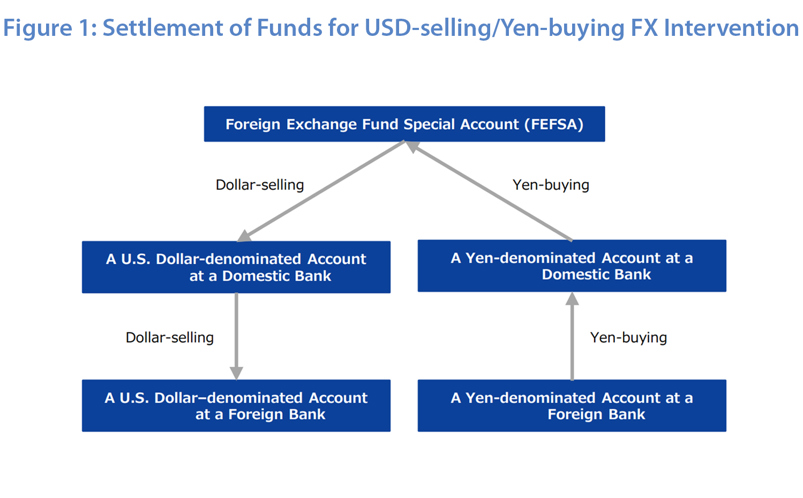
With respect to settlement of the yen leg of this trade, BoJ current account balances decline at the point when yen funds are transferred from a domestic bank’s yen account to the FEFSA. Because settlement takes place two business days after the intervention is conducted, if FX intervention had been carried out on or after January 23, it would appear as a change in the “Treasury and other factors” item in the BoJ’s “Factors Affecting Changes in Current Account Balances at the BoJ and Monetary Control” at some point. This is where BoJ watchers will be placing all of their attention in the weeks and months ahead if the yen continues to rally as it has recently.
Likely scenarios looking ahead
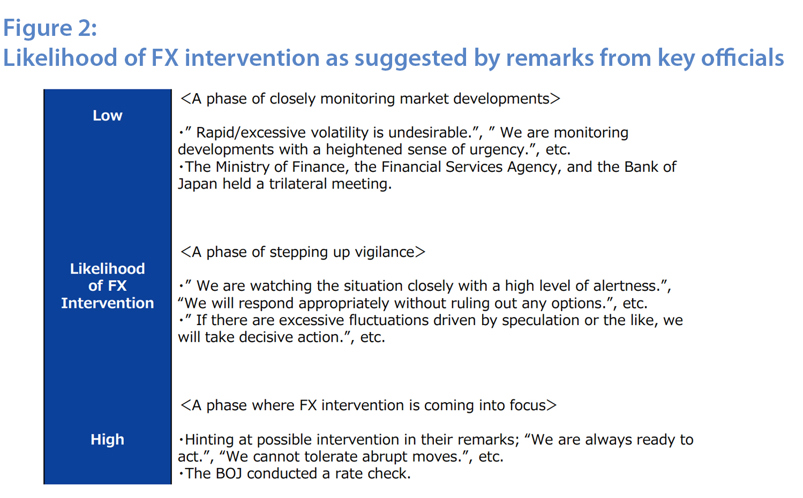
If we consider the possibility of FX intervention based on remarks by senior Ministry of Finance officials, the situation can be summarized as shown in Figure 2 below. If the yen’s sharp rise this time was driven by a rate check, the likelihood of FX intervention going forward would be high; if it was driven by actual FX intervention, the likelihood is high that intervention will continue intermittently. In addition, as the market has also been speculating that the Japanese and U.S. authorities acted in concert, moves toward yen depreciation are likely to be restrained for the time being.
Because FX intervention is intended to curb sharp exchange-rate fluctuations and promote stability, in the current situation it can be viewed as effective if it halts excessive yen depreciation and the market stabilizes. That said, the impact of FX intervention often proves temporary, and for the pullback in depreciation pressure to be sustained, we believe it will be necessary for the government’s fiscal policy to gain the market’s confidence and for the BoJ to conduct monetary policy appropriately.
Invest with us
If you have any account or dealing enquiries, please contact BBH using the following contact details:
Brown Brothers Harriman (Luxembourg) S.C.A.
80, route d’Esch, L-1470 Luxembourg
T: +352 474 066 226
F: +352 474 066 401
E: Lux.BBH.Transfer.Agent@BBH.com

Richard HAXE
Managing Director, Head of Business Development

Alex BARRY
Executive Director, Head of Distribution - UK and Ireland

Chloé CHOQUIN
Director, Business Development & Client Relations

Thomas CARTWRIGHT
Director, Business Development & Client Relations
|
Disclaimer An investment’s value and the income deriving from it may fall, as well as rise, due to market and currency fluctuations. Investors may not get back the amount originally invested. The information on this website is not intended to be investment advice, tax, financial or any other type of advice, and is for general information purposes only without regard to any particular user's investment objectives or financial situation. The information is educational only and should not be construed as an offer, solicitation, or recommendation to buy, sell, or transact in any security including, but not limited to, shares in any fund, or pursue any particular investment strategy. Any forecasts, figures, opinions or investment techniques and strategies set out are for information purposes only, and are based on certain assumptions and current market conditions that are subject to change without prior notice. The views of Sumitomo Mitsui DS Asset Management (UK) Limited reflected may change without notice. In addition, Sumitomo Mitsui DS Asset Management (UK) Limited may issue information or other reports that are inconsistent with, and reach different conclusions from, the information presented in this report and is under no obligation to ensure that such other reports are brought to the attention of any recipient of this report. Decisions to invest in any fund are deemed to be made solely on the basis of the information contained in the prospectus and the PRIIPS KID accompanied by the latest available annual and semi-annual report. |
 United Kingdom
 Switzerland
 Luxembourg
 Germany
 Finland
 Ireland
 Netherlands
 Rest of EEA
 Middle East
 Japan 日本
 Hong Kong 香港
 Singapore 新加坡
 USA
USA
 Other
Other